
While the speakers were presenting, the following illustrated summaries were created in order to visually summarize the key points from the sessions.
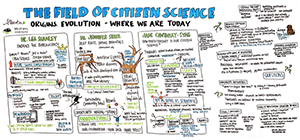
Speakers: Jade Cawthray-Syms, University of Dundee; Lea Shanley, US South Big Data Innovation Hub; Dr. Jennifer Shirk, Citizen Science Association
In Alberta, there are varying perceptions of what citizen science is – from an engagement tool to a tool to collect rigorous scientific data. The aim of this panel was to build awareness on how the field of citizen science has evolved, common challenges across the field, public involvement in citizen science programs, and opportunities for growth in the field.

Speakers: Kat Hartwig, Living Lakes Canada; Gary Redmond, Alberta Capital Airshed; Julie Vastine, Alliance for Aquatic Resources Monitoring
There are few clear and standardized processes, protocols, and support tools to guide the development, implementation, and evaluation of Alberta-based citizen science projects. This undermines the utility and limits the applicability of data and information generated through citizen science. Through a series of case studies, the Panel highlighted methods, guidelines and tools used in citizen science programs to enhance credibility and relevance.

Speakers: Bill Abercrombie, Alberta Trappers’ Association; Robert Anderson, Alberta Conservation Association; Danah Duke, Miistakis Institute; Elliot Fox, Kainai Ecosystem Protection Association; John Paczkowski, Alberta Environment and Parks; Bradley Peter, Alberta Lake Management Society
There are a variety of citizen science projects in Alberta ranging along the spectrum of participation (from contributory to co-created), purpose and objectives, and geographic scale (from local to international). This Panel highlighted place-based projects in Alberta.
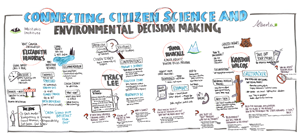
Speakers: Elizabeth Hendriks, WWF Canada; Tracy Lee, Miistakis Institute; Tanya Rushcall, Alberta Environment and Parks; KayeDon Wilcox, Alberta Environment and Parks
Engaging citizens in the scientific process can lead to a deeper understanding of critical environmental issues. There is a strong trend among government agencies and other organizations to incorporate citizen science as a tool to realize science, monitoring, and citizen engagement objectives. However, there is a lack of understanding around how to do so. This panel highlighted strategies and actions to enhance linkages between citizen science data and decision-making.
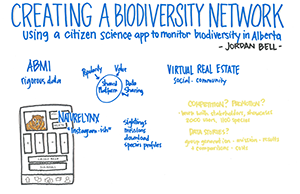
Speaker: Jordan Bell, Alberta Biodiversity Monitoring Institute (ABMI)
With the growing prevalence of biodiversity data collected by Albertans, the lack of a platform where anyone can contribute and share their citizen science data became apparent. Building off experience gained from its provincial monitoring program, the Alberta Biodiversity Monitoring Institute developed NatureLynx--a mobile and desktop citizen science application--to facilitate the establishment of a biodiversity network within Alberta.
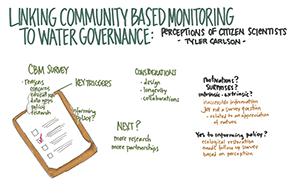
Speaker: Tyler Carlson, Simon Fraser University
This research assesses the structures and functions of community- based monitoring programs across Canada. Drawing on a nationwide survey of over one hundred organizations, we explore the reasons why communities undertake CBM, the monitoring protocols they follow, and the outcomes of CBM as perceived by citizen scientists.
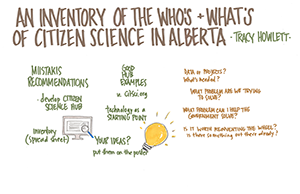
Speaker: Tracy Howlett, Alberta Environment and Parks – Environmental Monitoring and Science Division (EMSD)
Through 2015 and 2016, the Miistakis Institute was contracted by EMSD to produce a report which would establish “a foundation for the Chief Scientist and EMSD to understand the state of citizen science in Alberta and beyond, and to demonstrate the value of citizen science in supporting and advancing the development and implementation of an environmental science program”. In this presentation, the preliminary inventory will be shared as well as considerations for next steps in the development of a hub for sharing citizen science information in Alberta.
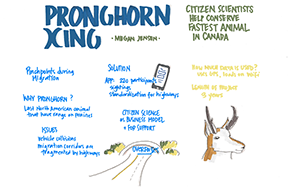
Speaker: Megan Jensen, Miistakis Institute
In the Northern Sagebrush Steppe (NSS), pronghorn undertake daily and seasonal migratory movements to meet life requirements. Across this region, highways fragment the landscape and cause direct morality and/or disrupt movement patterns. Pronghorn Xing is a citizen science program developed to ground truth seasonal migratory pinch-points identified by connectivity modeling across highways in the NSS and increase public engagement in pronghorn science and conservation.
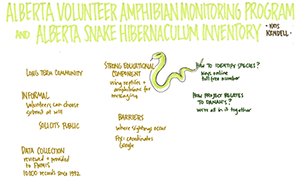
Speaker: Kris Kendell, Alberta Conservation Association
The Alberta Volunteer Amphibian Monitoring Program (AVAMP) is a long-term community survey of amphibians initiated in 1992, while the Alberta Snake Hibernaculum Inventory (ASHI) was initiated in 2000 and asks for voluntary information about snake dens and general reptile sightings. AVAMP and ASHI data collected by volunteers are submitted to ACA using an online data entry form on ACA’s website.
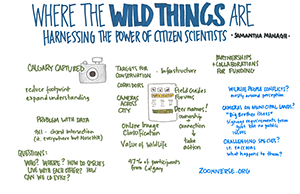
Speaker: Samantha Managh, City of Calgary
Calgary Parks has begun a multi-year wildlife camera study to better understand our wild neighbors. This project uses wildlife trail cameras to capture data about habitat use and wildlife movement around our urban environment with the aim of enhancing citizen eco-literacy through participatory stewardship action. Citizen- generated image classifications are a cost-effective means for Calgary Parks to understand species movement and barriers to movement, to enhance urban development and ecological network planning now and in the future.

Speaker: Cory Olson, Alberta Community Bat Program, Wildlife Conservation Society Canada
Wildlife Conservation Society Canada began the Alberta Community Bat Program in 2015 to promote bat conservation and to use citizen science to collect much-needed information on bats in human communities. The public is encouraged to submit roost observations and provide annual monitoring. Participants are asked to provide a guano (bat poop) sample, which allows reliable, inexpensive genetic species identification. Reports can be made directly to the program, or through a partner organization.

Speaker: Rob Schaufele, Collision Count)
Hwy #3 through the Crowsnest Pass has the third highest volume of traffic for a mountain pass in Alberta, resulting in high numbers of Wildlife/vehicle collisions; a concern for both human safety and wildlife connectivity. Collision Count is a Citizen Science project where participants collect data on the numbers of roadkill at specific wildlife mortality hotspots.
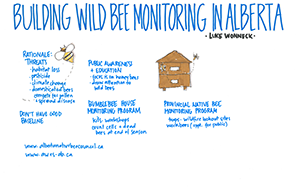
Speaker: Luke Wonneck, Alberta Native Bee Council; and, Agroforestry and Woodlot Extension Society
Wild pollinators provide crucial ecosystem services, but currently face a number of threats that include habitat loss, pesticide use, novel diseases, and climate change. In response, the recently formed Alberta Native Bee Council has initiated two wild pollinator monitoring programs, the “Bumblebee Box Monitoring Program” and the “Provincial Native Bee Monitoring Program”, created to monitor and provide insight into local bumblebee population levels year-to-year.
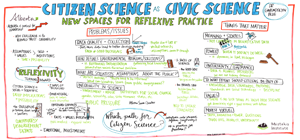
Speaker: Gwendolyn Blue, University of Calgary
Drawing on the collective discussions from the workshop, this presentation discussed the advantages and challenges associated with implementing different models of civic science. Central to this presentation is the importance of reflexivity – the examination of existing values, assumptions and power relations– as an important but often neglected component of civic science. This means taking time to surface and examine existing assumptions about science and the publics we imagine ourselves engaging with.
This is a summary of a survey completed post-event by attendees of the workshop.

